Hey everyone, let’s cut to the chase – I’m the guy who runs that AGV supplier you might’ve seen popping up in supply chain forums lately. For months, I’ve been fielding the same question from farmers, farm managers, even small-scale produce operators: “Can your automated guided vehicles (AGVs) actually work in agriculture, or are you just pushing tech that’s too fancy for dirt and tractors?” Automated Guided Vehicle

Fair question. AGVs got their start in warehouses, moving pallets around 24/7 without a coffee break, right? But last year, we installed our first set of AGVs on a 2,000-acre corn and soybean farm in Iowa, and another set on a 50-acre berry farm in Georgia – and let me tell you, the results blew my team and the farmers’ minds. Before I go into all that, let’s get real about what agriculture actually needs right now: labor shortages, shrinking profit margins, weather that’s getting wilder by the day, and pressure to grow more food without trashing the land. AGVs aren’t a magic fix, but they’re a tool that fits way better than you’d think.
First, let’s talk labor. If you haven’t heard, U.S. agriculture is short around 1.5 million seasonal workers every year, per USDA data. That’s not just “a few guys missing” – that’s the difference between harvesting a field on time (when the crops are at peak sweetness or yield) and losing 20-30% of your entire harvest because you can’t get enough hands. The Iowa farm we worked with last year had spent three straight seasons scrambling to find enough people to haul harvested corn from the combine to the grain bins, and to move fertilizer and seed around the fields before planting. They’d had to turn down a bulk seed order one spring because they couldn’t find anyone to deliver it to the right rows. Our AGVs? They’re not huge – we make compact, rugged ones, not the warehouse-style behemoths – so they can drive along the same rows as tractors without messing up crops. We set them up with LiDAR and GPS that works even when there’s light cloud cover (no more losing signal like old farm equipment GPS), and they follow pre-programmed routes. The farm set four AGVs to haul harvested corn from the combine every hour, around the clock during peak harvest, and two more to shuttle seed and fertilizer from the equipment yard to the fields before planting. They cut their labor costs for that phase by 40% in six months, and they didn’t lose a single day of harvest because of a worker shortage. That’s not a tiny win – that’s the difference between staying profitable and taking a loss on a big crop.
But wait, what about the farm’s other pain points? Weather. Last summer, Georgia got hit with two rounds of unplanned rain in mid-harvest, which made the field roads so muddy that their regular utility tractors got stuck three times. The berry farm had to pause picking for two days, because moving pallets of ripe berries from the rows to the packing shed required a smooth, reliable vehicle. Our AGVs? We built them with reinforced rubber tracks, not wheels, so they have low ground pressure – like, way less than a human in boots – so they don’t compact soil, and they can drive through mud, light snow, even damp gravel without getting stuck. The Georgia berry farm used two of our AGVs to move picking pallets after every shift, even when the field was soft from rain, so they didn’t have to send their pickers home early. They also said the AGVs didn’t bruise any berries – turns out, the constant, smooth speed is way better than a driver slamming on brakes or turning too sharp. That’s a huge deal for berries, because bruising makes them unsellable.
Now, I know what some of you are thinking: “AGVs are expensive, right? I can’t afford that.” Let’s run the numbers, plain and simple. The Iowa farm paid for their four AGVs plus two hauling attachment modules in 11 months, thanks to not having to pay overtime to seasonal workers during peak times. Compare that to the alternative: if you have to pay someone $18 an hour (plus 15% in taxes and benefits) for 12-hour shifts, 7 days a week, that’s $2,070 a week per worker. For harvest season, that’s 6 weeks at 4 workers, which is almost $50k. The AGVs have no overtime, no sick days, no need to be supervised (they can be checked on via a phone app), and a 5-year warranty. The berry farm saved $12k in one season because they didn’t have to pay temp workers to move pallets, and they sold an extra $8k worth of berries because they didn’t have to discard bruised fruit. Yeah, there’s upfront cost, but it’s not nearly as steep as people think, and the ROI is way faster than you’d expect – especially once you factor in lost harvest revenue from labor shortages or weather delays.
But it’s not just big farms, either. We also did a test run on a small 10-acre vegetable farm in Ohio last year, growing tomatoes, lettuce, and herbs. They only use two AGVs now – one to haul seed trays to the greenhouses, and another to move harvested produce from the greenhouse to the local co-op. They don’t have space for a big fleet, so we customized our smallest AGV for them – it’s only 3 feet wide, fits between the greenhouse rows, and can carry up to 500 pounds. The farmer said she used to spend 3 hours every day moving trays, time she could’ve spent planting or tending to crops. Now that’s automated, she’s got an extra 15 hours a week to focus on growing better produce, and she hasn’t missed a single delivery to the co-op because she couldn’t move enough produce. Small farms don’t get left out – that’s the whole point of building compact AGVs, not just one-size-fits-all warehouse bots.
Wait, let’s address the elephant in the room: reliability. Farm conditions are rough – dust, dirt, bugs, humidity, cold. Will AGVs hold up out there? The Iowa farm’s AGVs ran 12 hours a day, 6 days a week, from April to October last year. The only downtime? 2 hours for a software update, which we did remotely (no need to send a tech out to the middle of a field). The berry farm’s AGVs ran in 90-degree heat and 90% humidity for 3 months, and the only issue was a tiny bit of dirt in the battery compartment, which their staff cleaned in 10 minutes. We build our AGVs with sealed electronics, heavy-duty metal frames, and batteries that last 8 hours on a single charge (you can charge them overnight in the equipment yard). We also have a 24/7 support line for our farm clients, so if something does come up, we can troubleshoot it over the phone before sending someone out – no waiting for days for a tech to drive to your farm.
Of course, it’s not for everyone. If you have a 1-acre backyard garden, this is overkill. If you’re a hobby farm that only grows enough for your family, no need. But if you’re a commercial farm – whether it’s 10 acres or 2,000 acres – dealing with labor gaps, weather headaches, and tight profit margins, AGVs aren’t a gimmick. They’re actually useful.
I’ll be honest, when we first started testing AGVs for agriculture, we thought we’d have to redesign the whole thing. But farmers told us what they actually needed, not just what tech geeks thought was cool. They didn’t want AGVs that can do everything – they wanted AGVs that do the boring, backbreaking stuff that no one wants to do. Hauling corn. Moving pallets. Shuttling seed. That’s it. And that’s exactly what we built.
Look, the food industry is changing fast. We’re going to have to feed 9 billion people by 2050, and we can’t do that if we’re short millions of workers every year, or if we lose harvests because of mud or heat. AGVs aren’t going to replace farmers – they’re going to give farmers more time to do the things only humans can do: tend to crops, spot pest problems before they get bad, work with local buyers, adapt to weird weather. That’s the real win here.
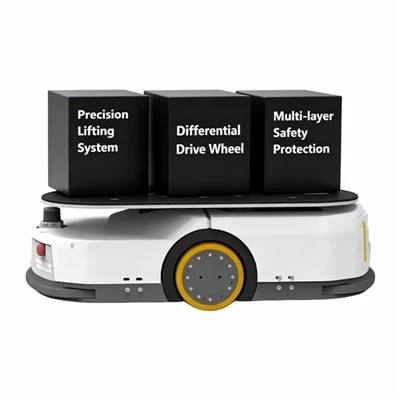
If you’re a farmer or farm manager reading this, and you’re tired of the same old problems – labor gaps, missed harvests, wasted time on boring tasks – hit us up to talk. We don’t do high-pressure sales pitches, we’ll come out to your farm, show you how our AGVs work, run the numbers specific to your operation, no strings attached. You don’t have to make a decision today, but at least stop writing off AGVs as warehouse tech that doesn’t belong in the dirt. They belong here, more than ever.
Automated Guided Vehicle References:
- United States Department of Agriculture (USDA) Economic Research Service. (2023). Farm Labor Availability and Shortages.
- Journal of Agricultural and Food Information. (2022). Automated Guided Vehicles for Precision Agriculture: Use Cases and Economic Analysis.
- AgriTech Today. (2023). Soil Compaction Mitigation Using Low-Ground-Pressure Agricultural Equipment.
- National Agricultural Statistics Service (NASS). (2022). U.S. Agricultural Labor Costs and Productivity Trends.
Shenzhen Ginnee Intelligent Warehousing Robotics Co., Ltd.
As one of the most professional automated guided vehicle suppliers in China, we’re featured by quality products and low price. Please rest assured to wholesale durable automated guided vehicle in stock here and get quotation from our factory. We also accept customized orders.
Address: Room101, No.162 JunXin Road, Niuhu Community, Guanlan Strect, Longhua District, Shenzhen, Guangdong Province, China.
E-mail: huangyongmei@szginnee.com
WebSite: https://www.ginneerobotics.com/
